Client
Coca-Cola
Region
North America and EU
Tech stack
Design program management and Technical delivery
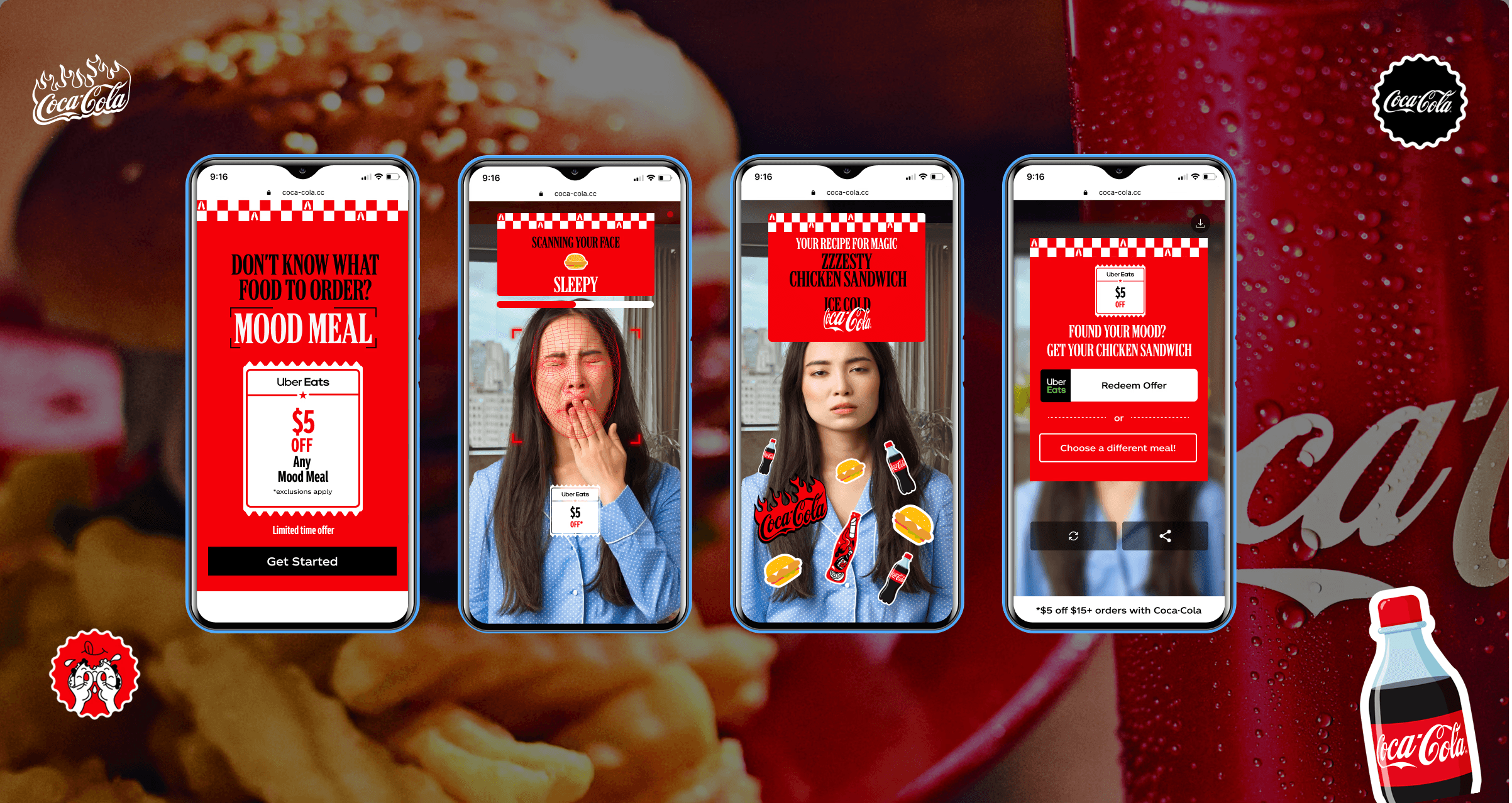
Through facial recognition technology, we built a web-based AR filter that analyzed users' moods to recommend a meal to match.
01 — The Brief
Emotions drive food choices, so the concept was direct: point your camera at your face, let computer vision detect your mood, and get a meal recommendation you could order immediately — with a $5 coupon for any Coke-carrying restaurant that matched. The experience had to work in a mobile browser with no app download, pass privacy review in two regulatory environments, hand off cleanly into a partner's ordering flow, and launch in sequence across markets with different food delivery ecosystems. Not only was the experience seamless between Coke's and Uber's/Wolt's infrastructure, 8th Wall's facial landmark technology ensured users' privacy by storing no face data. The app was first launched in North America then localized to EU markets through partnerships regional food service apps like Wolt. The result was a fun, shareable activation that made Coke part of the decision, not an afterthought.
02— The Delivery Challenge
The risk was sequencing
Every partner had a different definition of "ready." Uber's media placements were booked against fixed flight dates. Coca-Cola's legal review couldn't start until the privacy architecture was final. 8th Wall's build depended on locked creative.
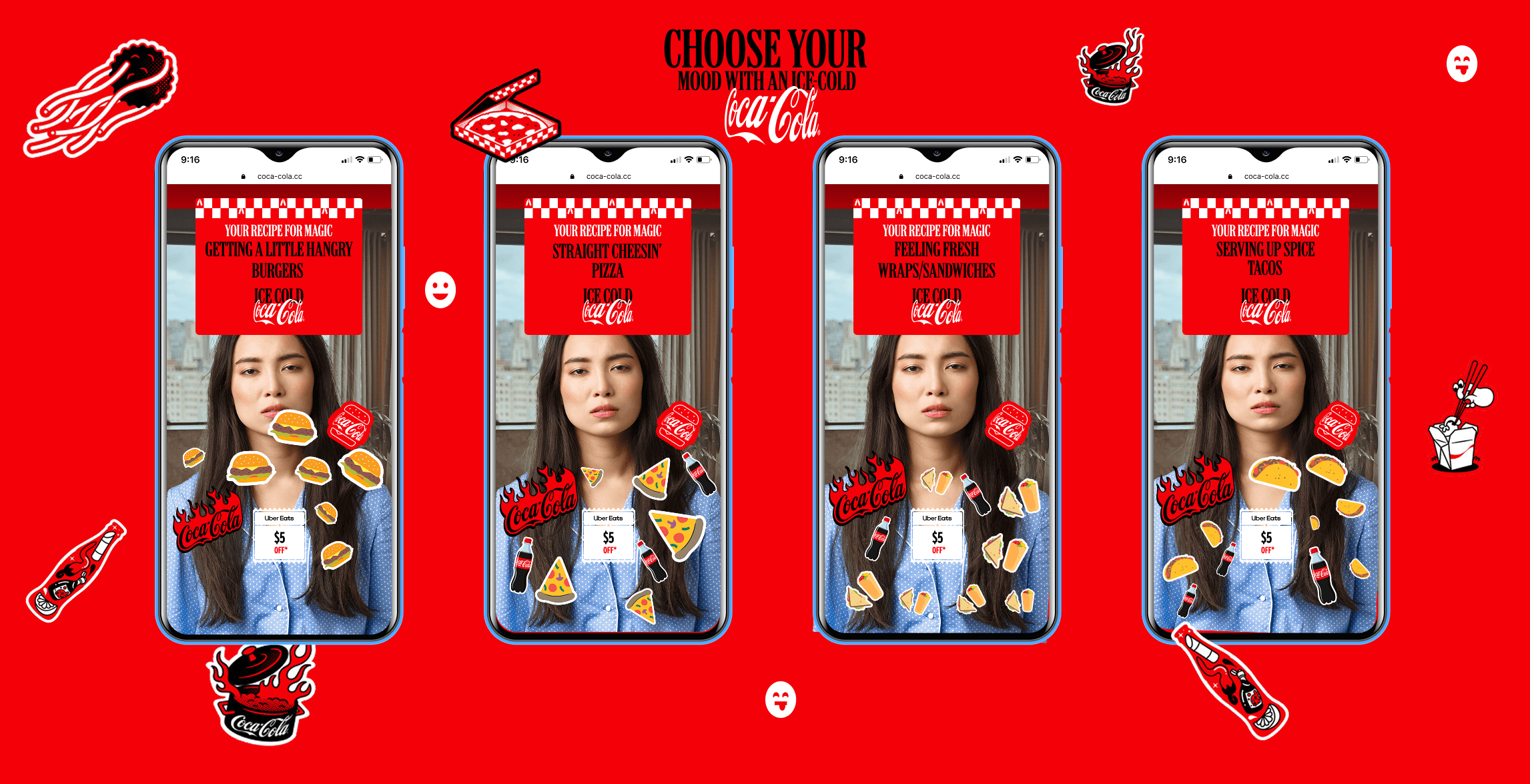
Personalized recommendations
In-session-only processing with zero retention meant a simpler legal path in both NA and the EU. Mood detection ran on computer vision: facial landmark analysis identified the user's expression in real time and mapped it to a meal category. We chose 8th Wall's web AR platform, which runs detection entirely in-session, in the browser. No face data was ever stored or transmitted.
Users could redeem a $5 coupon for any Coke-carrying restaurant that matched the result food type. The same core experience shipped to Greece and Romania with swapped redemption logic for Wolt and Bolt, no rebuilt necessary.
03 — What I Owned
→ Program plan and launch sequencing across NA and EU, including the localization roadmap for markets where Uber Eats had no presence → Partner coordination: Aligning Coca-Cola brand and legal, Uber product and media, Wolt and Bolt regional ops, and creative agency partnership → Technical scoping and technical program management → Media integration: Connecting the experience to a paid funnel across Meta and Uber's owned channels